
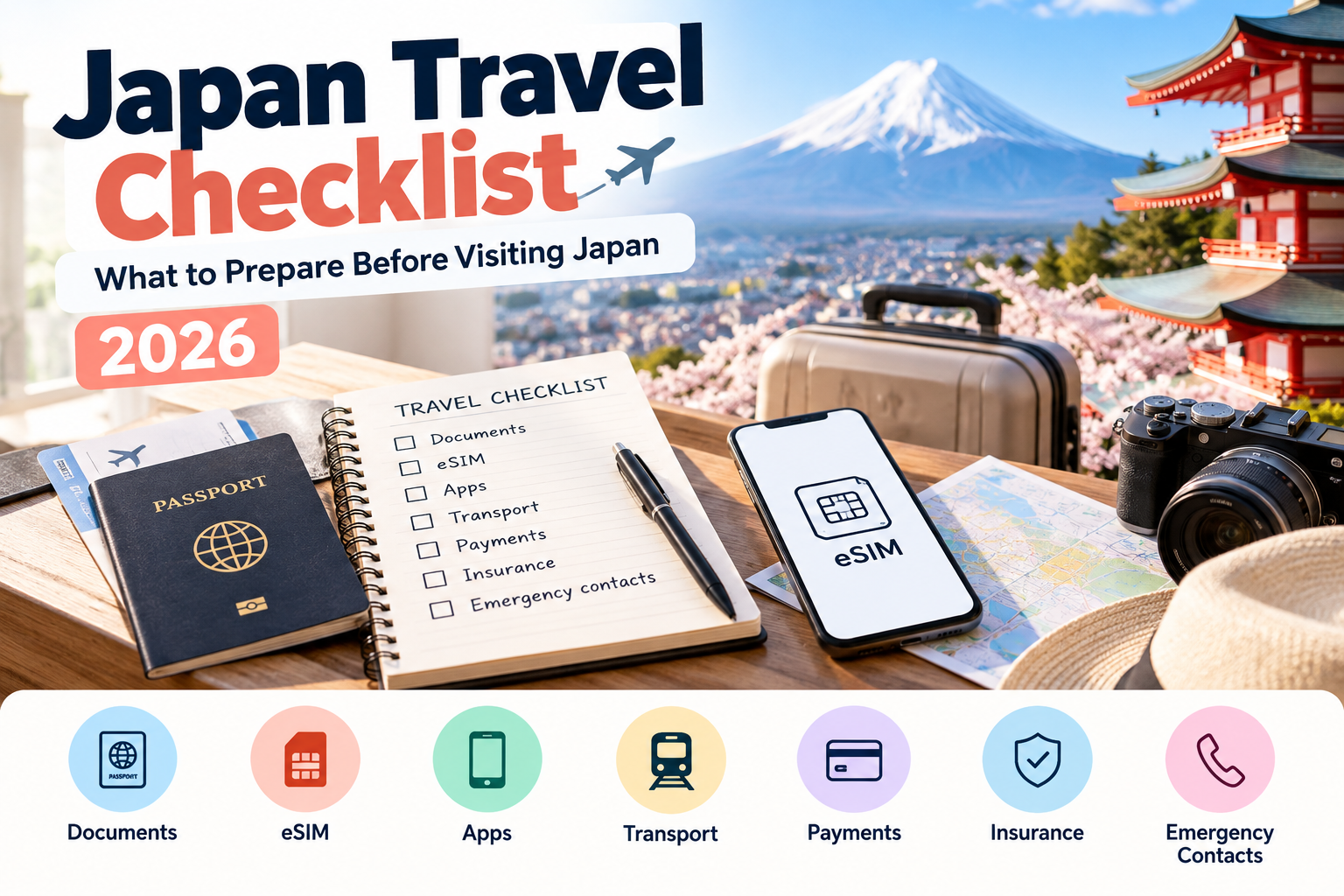
Planning your first trip to Japan? Use this practical checklist to prepare the essentials before departure, reduce avoidable problems, and know where to find reliable information. Requirements can change, so always confirm official guidance for your nationality and itinerary.
Last checked: November 18, 2026 (Japan time).
Japan Entry Requirements in 2026
Check the rules for your passport, travel purpose and planned length of stay before booking non-refundable travel.
Visa
Many travelers can visit Japan without a visa for a short tourist stay. The permitted length of stay and passport conditions vary. Check the Ministry of Foreign Affairs’ visa exemption list and its visa guidance for your situation.
Passport
Make sure your passport is valid for your entire stay in Japan. Check any additional document or validity requirements with your airline and the authorities of any country you will transit through. See Japan’s consular passport guidance.
Visit Japan Web
Visit Japan Web is a free, optional service for entering immigration and customs information before arrival. You still need to complete the required arrival procedures, including the customs declaration.
JESTA (Japan’s electronic travel authorization)
As of November 18, 2026, travelers do not need JESTA to enter Japan. Japan passed legislation to establish the system on May 29, 2026. The Immigration Services Agency aims to introduce it during fiscal year 2028. Check the Immigration Services Agency’s official updates before you travel.
Tax-free shopping after arrival
Japan switched to a refund system for eligible tax-free purchases on November 1, 2026. You pay the tax-inclusive price at the shop and receive the refund after Customs confirms at departure that you are taking the goods out of Japan. See Japan Tax-Free Shopping Changes.
Quick Japan travel checklist
- Check passport validity, visa requirements and entry procedures for your nationality.
- Confirm flight, accommodation address, check-in rules and travel insurance details.
- Check whether your phone is unlocked and supports your preferred eSIM.
- Install essential navigation, translation and transport apps before departure.
- Prepare a payment backup and learn how IC cards work.
- Review customs, medication and tax-free shopping rules using official sources.
- Save emergency contacts and offline copies of important documents.
1. Check entry requirements first
Review the entry requirements above before booking. If you use Japan eVISA, follow the official Japan eVISA guidance to display the visa issuance notice online at the airport. Screenshots, PDFs and printed copies are not accepted.
2. Set up mobile internet
Check whether your current mobile plan already includes Japan roaming before buying extra data. Our Japan eSIM vs roaming cost guide explains the options and possible charges. If you need local calls or SMS codes, first check whether you need a Japanese phone number.
Reliable internet helps with train routes, maps and translation. For connectivity immediately after landing, see our free Wi-Fi guide for Narita, Haneda and Kansai airports. Compare an eSIM with pocket WiFi based on your phone compatibility, number of travelers, hotspot needs and expected data use. Be careful with “unlimited” plans: some have high-speed usage policies or speed reductions.
- Compare eSIM options for Japan
- Compare eSIM prices for 7-, 14- and 30-day trips
- Understand unlimited eSIM speed limits
- Compare pocket WiFi services
- Check when to install and activate your Japan eSIM
- Fix eSIM connection problems after arrival
3. Download helpful travel apps
Install your map, route-planning and translation tools while you still have a dependable connection. Download offline map areas or language resources where supported, and sign in before your flight. See our 10 useful apps for Japan travel guide.
4. Prepare transportation and payments
Check how you will travel from the airport to your accommodation, especially if you arrive late. Consider an IC card for eligible transport and small purchases, but keep an alternative payment method. Availability, purchase locations, refunds and mobile support vary by card and device. Read Suica vs PASMO for tourists.
If you are traveling between cities with large suitcases, consider whether hotel-to-hotel delivery would make your journey easier. Check delivery times and whether your next hotel accepts parcels before sending anything. See our luggage forwarding in Japan guide for costs, deadlines and common mistakes.
5. Review shopping and customs rules
Do not assume every purchase is eligible for tax-free treatment. Check the current rules, the timing of any changes and the required procedures before shopping. Our Japan tax-free shopping guide explains important changes; confirm the latest details with the National Tax Agency. Everyone entering Japan must submit a customs declaration for accompanied and unaccompanied articles, including travelers who have nothing to declare. You can use the electronic declaration service through Visit Japan Web; check Japan Customs for the current procedure. Medicines may be subject to quantity limits or advance import confirmation, and certain controlled medicines require special permission or may be prohibited. Check the Ministry of Health, Labour and Welfare guidance before packing. For eligible purchases made on or after November 1, 2026, you pay the tax-inclusive price at the store. You receive the consumption tax refund after Japan Customs confirms at departure that you are taking the goods out of Japan. See the National Tax Agency for eligibility and departure procedures.
6. Save important details for emergencies
If your passport is lost or stolen during your trip, follow our step-by-step guide to a lost passport in Japan for advice on reporting the loss and contacting your embassy.
For non-emergency problems involving shops, restaurants or hotels, save our Japan Tourist Consumer Hotline guide before your trip. The official service provides consumer advice during its published operating hours.
Keep your hotel address in Japanese, your travel insurance contact, emergency contact details and copies of key documents in a secure place you can access offline. In Japan, police emergencies use 110 and fire or ambulance emergencies use 119. If your passport is lost, contact your embassy or consulate and the relevant local authorities for instructions.
7. Do a final check 48 hours before departure
- Recheck entry requirements and airline notices.
- Confirm booking dates, airport and accommodation location.
- Test app logins and save offline directions.
- Confirm how and when your mobile data plan activates.
- Check payment cards and access to emergency funds.
- Review the latest official guidance for medicines and restricted items.
When to prepare: 7 days, 48 hours and departure day
Seven days before departure
Check your passport, visa situation and airline booking details. Confirm that the name on your ticket matches your travel document. Review your accommodation’s check-in hours, especially if you will arrive after midnight. Decide whether an eSIM or pocket WiFi better suits your group, and make sure your phone can use the service you choose.
Forty-eight hours before departure
Recheck official entry and customs guidance, including any rules affecting medicines you plan to bring. Save your accommodation’s name, address and phone number in Japanese and English. Download offline maps if your navigation app supports them. Save confirmation numbers and your insurance provider’s emergency contact in a secure location accessible without mobile data.
On departure day
Keep your passport, phone, charging cable and essential medication in your carry-on bag, subject to airline and security rules. Check that you can access your booking details without an internet connection. Have a plan for reaching your accommodation from the arrival airport, and keep a backup payment method separate from your main wallet.
What if your phone has no internet when you arrive?
First, check whether your travel data plan has activated and whether the required mobile data settings are enabled. Follow your provider’s setup instructions rather than changing settings at random. If you cannot connect, use a trusted airport information desk or an available Wi-Fi network to contact your provider. Offline maps, a saved hotel address and a screenshot of your airport transfer instructions can help you continue your journey while you troubleshoot.
Editorial note: This is a planning checklist, not immigration, medical or legal advice. Requirements and provider conditions can change. Check official sources before traveling.