
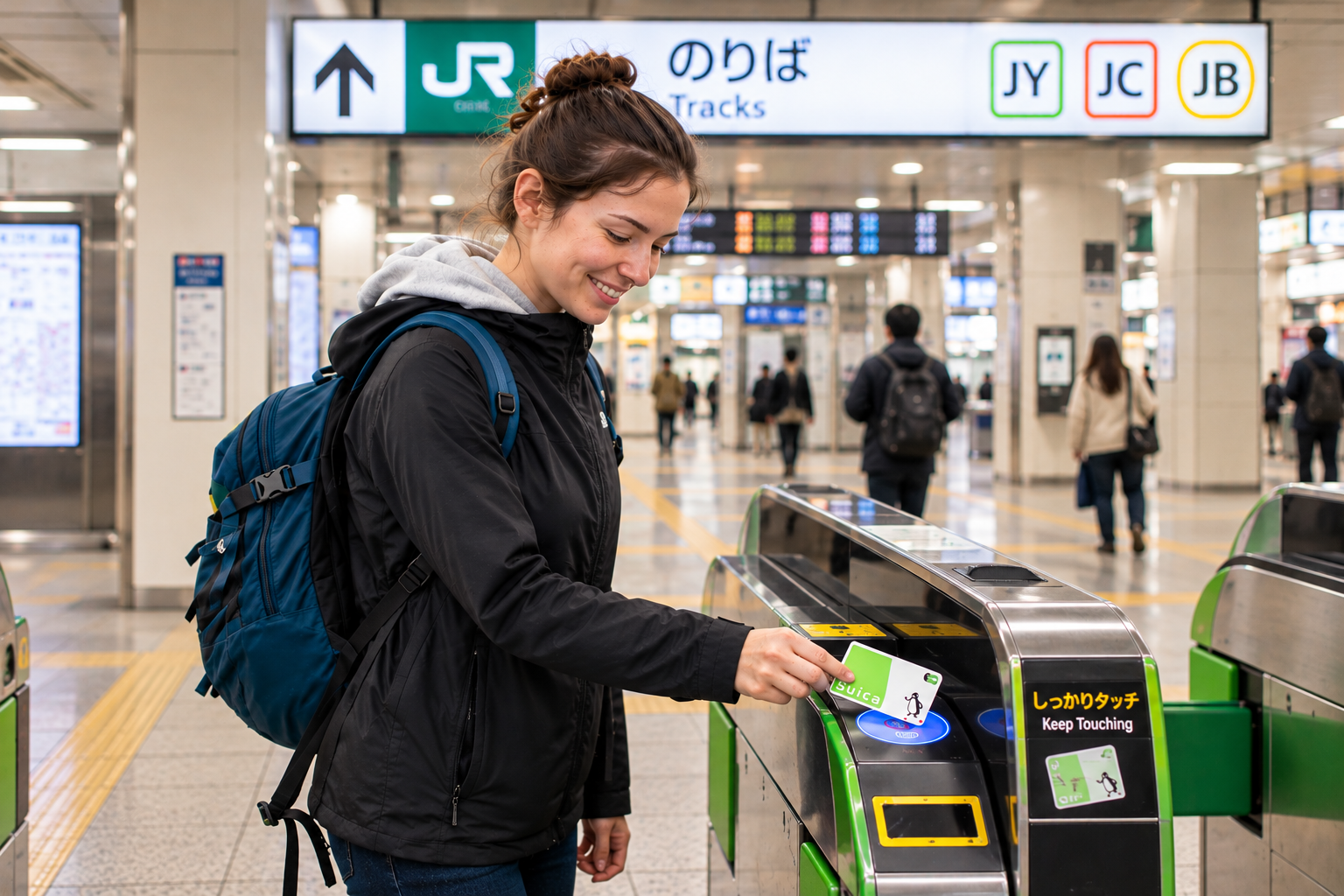
Suica vs PASMO in Japan: For most short-term visitors, either card works well on participating trains, buses and shops. The bigger decision is whether to use a regular card, a visitor card, or a compatible phone. Last checked: October 19, 2026 (Japan time).
Suica vs PASMO in Japan: Which Card Should Tourists Choose?
Quick answer: Choose the card you can conveniently obtain at your arrival airport or station. Suica and PASMO participate in Japan’s interoperable transit IC network, so most travelers do not need both. Neither card works on every route nationwide.
| Option | Best for | Key limitation |
|---|---|---|
| Regular Suica | Travelers wanting a reusable physical card | ¥500 deposit; refund conditions and fees apply |
| Regular PASMO | Travelers buying at a PASMO operator’s station | ¥500 deposit on a standard physical card; card return is required for a balance and deposit refund |
| Welcome Suica (physical) | Short visits, especially when arriving at an airport sales point | 28-day validity; unused balance generally not refunded |
| TOURIST PASMO | Short visits arriving via participating Haneda or Narita airport stations | 28-day validity; no unused-balance refund |
| Welcome Suica Mobile | Visitors with compatible Apple devices | 180-day validity; unused balance is not refundable; Apple device and payment compatibility must be checked |
Suica vs PASMO: Can You Use Either in Tokyo?
Yes. Both are prepaid transportation IC cards used for fares on participating railway and bus systems and payments at participating shops. Look for the nationwide IC interoperability symbol or the relevant card logo. Some rural lines, services and cross-region trips are not covered, so check your route before relying on an IC card.
Important: You generally cannot use a single IC tap-in journey to travel directly between separate IC service areas, such as the Tokyo area and another region. A separate ticket may be necessary. Shinkansen and certain express services may also require a separate ticket or additional reservation.
Tourist IC Cards in 2026: Welcome Suica and TOURIST PASMO
Welcome Suica (physical card)
JR East’s physical Welcome Suica is valid for 28 days from purchase and has no deposit. It is sold at specified JR East travel centers and dedicated machines, including listed locations at Narita Airport and Haneda Airport Terminal 3. Sales points and availability can change, so consult the official JR East sales guide before traveling.
Unused stored value is generally not refunded when your trip ends. JR East describes a separate procedure for certain card malfunctions; this is not a normal end-of-trip refund.
TOURIST PASMO
TOURIST PASMO launched in 2026 as a special card mainly for international short-term visitors. It is sold at designated Haneda and Narita airport railway locations, has 28-day validity, and requires no deposit. The card’s remaining stored value is not refundable. Available purchase amounts vary by sales location. See the official TOURIST PASMO page for current sales counters, machines and prices.
Do not confuse it with PASMO PASSPORT: PASMO PASSPORT was discontinued. Older travel guides may still mention it.
Can You Use Suica or PASMO on an iPhone or Android?
Compatible iPhones and Apple Watches can use supported transit cards through Apple Wallet. JR East also offers Welcome Suica Mobile for supported Apple devices. Check the latest device, operating-system and payment requirements before departure; an overseas-issued payment card may not work in every top-up flow.
Android warning: Many Android phones bought outside Japan are not compatible with Mobile PASMO. PASMO’s official English guidance explicitly warns about this, and its Android support is generally in Japanese. If compatibility is uncertain, a physical card is the safer choice. See PASMO’s official guidance.
Where to Buy and Top Up
Regular Suica cards are available at designated JR East ticket machines and ticket offices, subject to current sales arrangements. Regular PASMO cards are available at participating PASMO operators’ machines or counters. Visitor cards have more limited designated sales points.
For physical visitor cards, cash top-ups are available at supported station machines and some shops or ATMs. TOURIST PASMO can be topped up at compatible station machines and participating convenience stores. The maximum stored balance is generally ¥20,000; specific top-up limits vary by machine and method. Keep some Japanese yen in cash in case a machine does not accept your payment method.
Where IC Cards Do Not Work
- Not every train, bus or shop accepts Suica or PASMO, even if it is in Japan.
- Crossing between separate IC fare areas may require a paper or separately booked ticket.
- Limited express and Shinkansen journeys can require an additional ticket or specific IC-linked booking.
- Do not assume your IC balance covers the entire fare until you check the route.
Refunds, Expiration and Avoiding Unused Balance
Welcome Suica (physical) and TOURIST PASMO: both normally expire after 28 days, and remaining stored value is not refunded for ordinary end-of-trip reasons. Avoid adding more money than you expect to use.
Regular Suica: JR East states that its standard physical card includes a ¥500 deposit, refunded when returned. A handling fee of up to ¥220 is deducted from the remaining stored value; the deposit is returned. Returns are handled by the issuing operator under its rules.
Regular physical PASMO: PASMO states that returning the card allows a refund of the remaining stored value and the ¥500 deposit. You cannot refund only the balance while keeping the card. Different rules apply to certain special and integrated cards, so check the issuer’s terms.
Welcome Suica Mobile: JR East says it is valid for 180 days from issuance, and any remaining balance expires without a refund. It is different from the 28-day physical Welcome Suica card. Other mobile IC products have their own terms; check them separately.
Common Mistakes and Quick Fixes
- Buying two cards unnecessarily: Suica and PASMO usually serve the same practical purpose on participating networks.
- Adding too much money: visitor cards generally do not refund unused stored value.
- Assuming every Android phone works: verify compatibility before depending on a mobile card.
- Trying to ride between separate IC areas: check whether you need a separate ticket.
- Ignoring a gate error: ask station staff to inspect the card rather than repeatedly tapping.
For planning train routes and getting around Japan, see our guide to 10 useful Japan travel apps, including navigation and transit tools.
Official Sources
- JR East: Welcome Suica purchasing, top-up and refunds
- JR East: Welcome Suica validity and areas
- JR East: standard Suica and refunds
- PASMO: TOURIST PASMO purchasing and terms
- PASMO: standard PASMO, refunds and interoperability
- JR East: Welcome Suica Mobile (180-day validity and refunds)
- PASMO: mobile and Android compatibility guidance
Official sources checked October 19, 2026. Station availability and mobile compatibility may change. This guide describes ordinary short-term tourist use; special or long-stay products may have different conditions.