
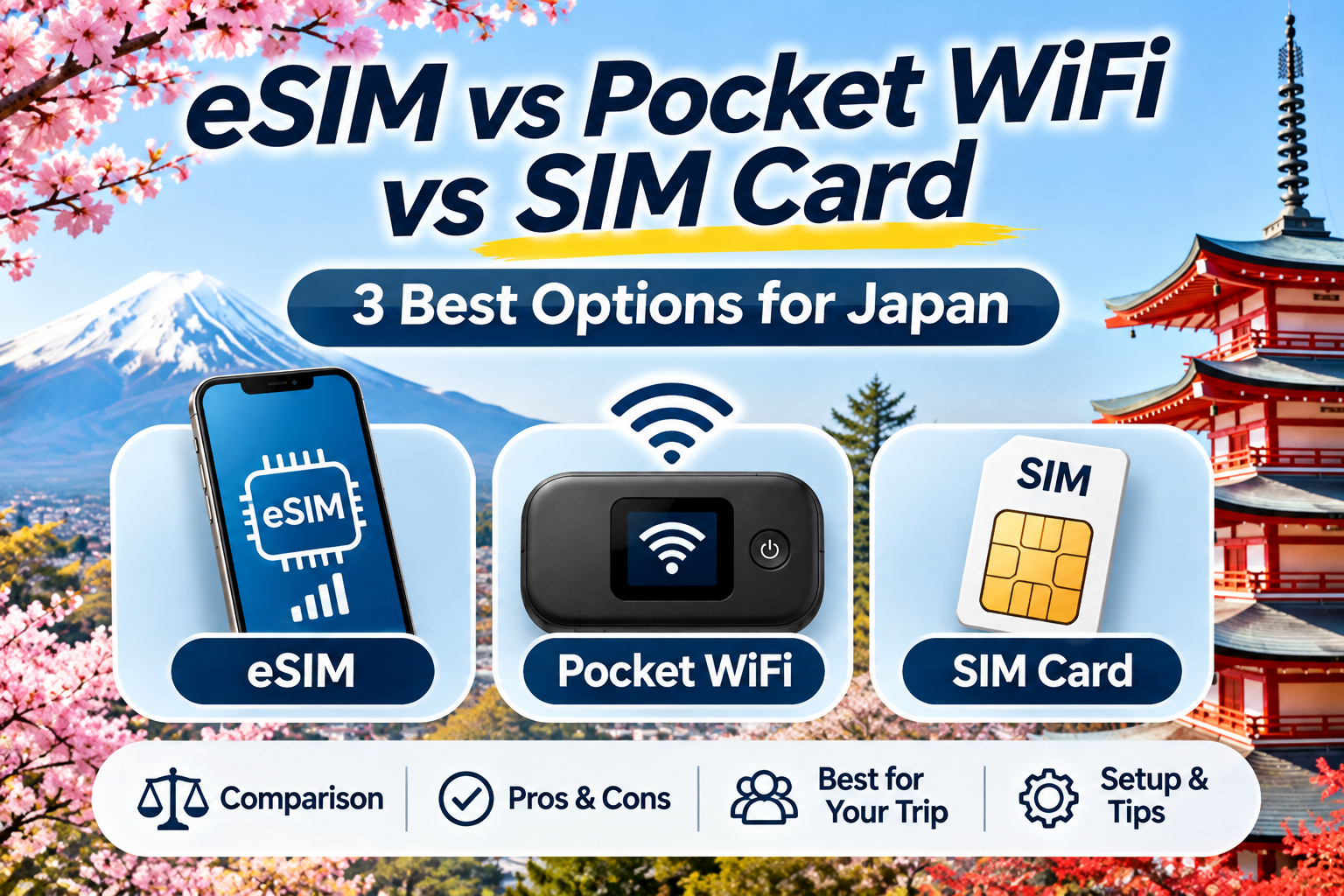
eSIM vs Pocket WiFi vs SIM Card — which is best for traveling in Japan?
Staying connected in Japan is essential for maps, train routes, translations, restaurant searches, and keeping in touch while you travel. But should you choose an eSIM, rent a pocket WiFi, or buy a physical SIM card?
The best option depends on your phone, the number of people traveling with you, and how much data you expect to use. In this guide, we compare eSIMs, pocket WiFi, and SIM cards for Japan to help you choose the simplest option for your trip.
Quick Answer
For most solo travelers to Japan, an eSIM is the easiest option. You can set it up before arrival, connect as soon as you land, and avoid carrying or returning an extra device.
Pocket WiFi is a better choice for families or groups who want to share one connection across several devices, while a physical SIM card can be useful if your phone does not support eSIM.
In short:
eSIM: Best for most solo travelers and couples
Pocket WiFi: Best for families, groups, and multiple devices
SIM card: Best for travelers with non-eSIM-compatible phones
Our Top Picks
Best eSIM for Most Travelers
Ubigi is our top eSIM pick for Japan for its range of data plans and straightforward setup on compatible, unlocked phones. It is a convenient choice for travelers who want to get connected without picking up or returning a physical device.
Best Pocket WiFi for Families and Groups
NINJA WiFi is a convenient option for families and groups who want to connect multiple devices during their trip to Japan. One pocket WiFi device can be shared across smartphones, tablets, and laptops, making it a practical choice when several people need internet access at the same time.
Best Physical SIM for Travelers Who Need a SIM Card
Mobal is a practical choice for travelers who prefer a physical SIM card or have a phone that does not support eSIM. It offers tourist SIM options for Japan with English-language support and plans designed for short-term visitors.
eSIM vs Pocket WiFi vs SIM Card Comparison
| Option | Setup | Sharing | Main advantage | Best for |
|---|---|---|---|---|
| eSIM | Digital | Phone hotspot if supported by the plan and device | No rental device; digital setup on a compatible phone | Solo travelers & couples |
| Pocket WiFi | Rental device | Multiple devices | Easy sharing | Families & groups |
| Physical SIM | Insert SIM card | Phone hotspot if supported by the plan and device | Works on non-eSIM phones | Travelers without eSIM support |
How We Chose Our Recommendations
We compared eSIMs, pocket WiFi, and physical SIM cards based on setup difficulty, device compatibility, the number of devices that can connect, convenience during travel, and overall suitability for different types of visitors to Japan.
We also considered whether each option requires picking up or returning equipment, whether it can be prepared before arrival, and how practical it is for solo travelers, couples, families, and groups.
Detailed Reviews
eSIM: Best for Most Travelers
An eSIM is often the simplest option for travelers with an unlocked, eSIM-compatible smartphone. You can usually buy and prepare it before your trip, but installation, activation, and the start of the plan’s validity period depend on the provider. Follow the provider’s instructions carefully. There is no physical SIM card to swap and no rental device to return.
For most solo travelers and couples, this is the option we recommend first because it is convenient and easy to manage. Ubigi is our current top eSIM pick for Japan.
Pocket WiFi: Best for Families and Groups
Pocket WiFi is useful when several people or devices need internet access at the same time. One rental device can connect multiple smartphones, tablets, or laptops, so it can be a practical choice for families and groups traveling together.
The trade-off is that everyone sharing the connection needs to stay within WiFi range of the router. You also need to carry and charge it, and arrange pickup and return. Delivery, late returns, or lost equipment may lead to extra charges depending on the rental terms. NINJA WiFi is our current pocket WiFi option for groups.
Physical SIM: Best for Phones Without eSIM
A physical SIM card is still a useful option for travelers whose phones do not support eSIM or who simply prefer using a traditional SIM. Once installed, it works directly in your phone without requiring a separate WiFi device.
Check that your phone is unlocked and supports the SIM provider’s network bands. You may need to remove your existing SIM, unless your phone has a suitable second SIM slot. Check the plan carefully: some tourist SIMs are data-only and do not include standard phone calls or SMS. Mobal is our current physical SIM option for short-term visitors.
Frequently Asked Questions
Is eSIM better than pocket WiFi in Japan?
For most solo travelers and couples, an eSIM is usually more convenient because there is no extra device to carry, charge, pick up, or return. Pocket WiFi can be a better choice for families or groups who want to share one connection across multiple devices.
Can I use a physical SIM card in Japan instead of an eSIM?
Yes. A physical SIM card is still a good option if your phone does not support eSIM or if you prefer using a traditional SIM. Just make sure your phone is unlocked and compatible with the network used by the SIM provider.
How do I know if my phone supports eSIM?
Most recent iPhones, Google Pixel phones, and many Samsung Galaxy models support eSIM, but compatibility varies by model and country. Check your phone settings or the manufacturer’s specifications before purchasing an eSIM for Japan.
How many devices can connect to a pocket WiFi in Japan?
The number of devices depends on the rental provider and device model, but pocket WiFi is generally designed to connect multiple devices at the same time. This makes it useful for families, groups, or travelers carrying several devices.
What Can Go Wrong?
- Incompatible phone: Check that your phone is unlocked and supports eSIM or the physical SIM’s network bands before paying.
- Unexpected data limits: Compare the data allowance, validity period, fair-use rules, and hotspot support for the exact plan you choose.
- Extra rental charges: For pocket WiFi, check pickup and return locations, delivery charges, return deadlines, and loss or damage terms.
- Missing phone services: Many travel eSIM and tourist SIM plans provide data only. Check whether voice calls and SMS are included if you need them.
How to Choose Before You Buy
- Check whether your phone is unlocked and eSIM-compatible.
- Estimate your trip length, data usage, and how many devices need internet at the same time.
- If you travel separately from your group, consider whether each person needs their own connection rather than sharing one pocket WiFi router.
- Review the exact plan’s activation timing, hotspot rules, coverage, data limits, and total cost before checkout.
- If renting pocket WiFi, confirm pickup, return, and any extra fees before ordering.
Related Comparisons and Setup Guides
- Best eSIMs for Japan — compare individual eSIM providers and plans.
- Best Pocket WiFi for Japan — compare rental options for groups and multiple devices.
- How to Use an eSIM in Japan — check compatibility and setup steps.
Official Sources
- Ubigi Help Center: tethering and data sharing
- NINJA WiFi: delivery, return, and shipping fees
- NINJA WiFi: airport pickup and return
- Mobal: Japan SIM plans and device compatibility
Information checked: November 14, 2026. Prices, plan features, and rental terms can change. Confirm current conditions on the provider’s website before purchasing.
Affiliate Disclosure
Some links on this page may be affiliate links. NewtoJapan may receive a commission if you purchase through these links, at no additional cost to you. Our recommendations are based on our research and comparison criteria.