
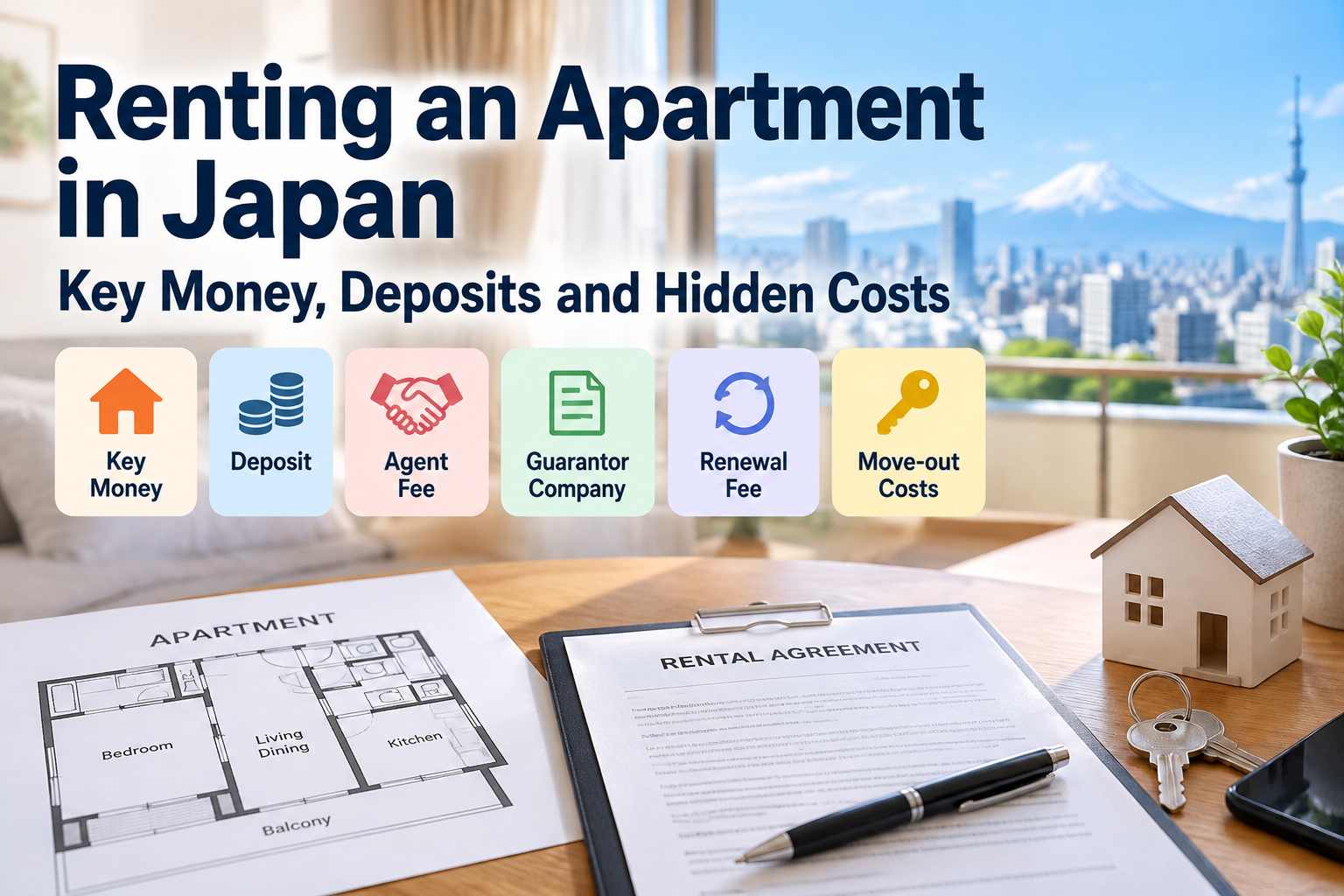
Renting an apartment in Japan can involve more than the monthly rent. Before signing, ask for a written breakdown of the move-in costs, ongoing charges, renewal terms and move-out obligations. This guide explains common Japanese rental terms and practical checks for international residents.
Quick answer: what will you pay?
Depending on the property and contract, upfront costs may include a security deposit (shikikin), key money (reikin), an agency fee, a guarantor-company fee, advance rent, insurance and other agreed charges. Not every fee applies to every apartment. Request an itemized quotation rather than assuming a standard total.
Security deposit (shikikin): what happens to it?
Shikikin is money held as security for obligations under the lease. At the end of the tenancy, the balance is generally returned after legitimate deductions, such as unpaid rent or tenant-responsible damage. It is not automatically forfeited, but it is not guaranteed to be refunded in full. Ask how deductions are calculated and when the balance will be returned.
Key money (reikin): is it refundable?
Reikin is commonly described as a non-refundable payment to the landlord. Some listings charge it and others do not. Confirm the amount, purpose and refund terms in the specific contract before paying. Do not confuse key money with a security deposit.
Agency fees, guarantor fees and other upfront charges
A real estate agency may charge a brokerage fee, subject to applicable rules. For residential rentals, the usual tenant-side limit without advance consent is 0.55 months’ rent including tax. With advance consent, up to 1.1 months’ rent including tax may be charged to the tenant, subject to the applicable overall limit. Ask for a clear explanation before agreeing. A rent-guarantee company may also charge an initial fee and recurring or renewal fees. You might additionally see fire insurance, lock replacement, cleaning or support-service charges. Ask which charges are required, who receives them, whether they recur and whether any optional service can be declined. Do not assume every quoted fee is mandatory or lawful without reviewing its basis.
Example: compare the full cost, not just the rent
For illustration only, imagine an apartment with monthly rent of ¥80,000 and a quotation that includes one month’s deposit, one month’s key money, one month’s agency fee, one month’s advance rent and ¥40,000 in other charges. That totals ¥360,000 before any additional taxes, prorated rent or fees. This is an arithmetic example, not a market average or a required fee schedule. Another property may have a very different breakdown.
Renewal fees and lease types
Some leases include a renewal fee, while others do not. Check the lease period, renewal procedure, any guarantor-company renewal charge and the deadline for notifying the landlord if you plan to leave. Also confirm whether the agreement is an ordinary lease or a fixed-term lease: renewal rights and end-of-term procedures can differ. A valid fixed-term lease generally ends when its term expires without automatic renewal; continuing to live there ordinarily requires a new agreement, and statutory notice rules may apply.
Move-out costs: normal wear versus damage
Japan’s Ministry of Land, Infrastructure, Transport and Tourism (MLIT) publishes guidance on restoration costs (genjo kaifuku). In general, ordinary wear and deterioration from normal use should be distinguished from damage caused by misuse or negligence. Actual liability depends on the facts, applicable law and valid contract terms. A cleaning or repair charge should not be assumed correct simply because it appears on an invoice. Request an itemized explanation if you disagree. Special cleaning or restoration clauses are not automatically enforceable merely because they appear in a lease. Their wording, explanation, agreement and applicable law matter.
Deposit vs key money: a simple comparison
A security deposit is generally held against outstanding lease obligations, with the remaining balance returned after permitted deductions. Key money, where charged, is generally non-refundable. When renting an apartment in Japan, ask for both amounts to be identified on the written estimate. A zero-deposit listing may still involve other upfront or move-out costs.
Example move-out dispute: stained wallpaper
Suppose a landlord asks you to pay for replacing an entire room’s wallpaper. Ask what damage is attributed to you, whether it exceeds ordinary wear, how the replacement area and depreciation were assessed, and which contract provision applies. The MLIT guidelines distinguish normal wear from tenant-caused damage but do not automatically invalidate every charge. Keep dated photos and request an itemized breakdown.
Renting an apartment in Japan: questions to ask before signing
- Could you show me an itemized estimate of all move-in costs?
- Which fees are refundable, and under what conditions?
- Are cleaning, lock-change and support-service charges required?
- What are the guarantor-company fees now and at renewal?
- Is this an ordinary or fixed-term lease, and what happens at the end?
- How much notice must I give before leaving, and is there an early-termination fee?
- How are damage and deposit deductions assessed?
A practical checklist before you sign
- Get the total initial-cost estimate in writing, including taxes and prorated rent.
- Check which payments are refundable, non-refundable, recurring or optional.
- Read the rent, management fee, payment deadline and late-payment provisions.
- Check the guarantor requirements and the guarantor-company fee schedule.
- Confirm the lease type, renewal fee, early-termination penalty and notice period.
- Ask who pays for repairs, cleaning and restoration at move-out.
- Document existing scratches, stains and equipment problems with dated photos when you move in.
- Keep copies of the signed lease, important-matters explanation, receipts and condition checklist.
Help for foreign residents
MLIT provides a rental housing support page for foreign nationals, including multilingual contract examples and checklists. Materials are available in English and several other languages, including Myanmar (Burmese). Ask the agent for explanations in a language you understand before signing.
Official sources
- MLIT: Private rental housing guidance
- MLIT: Restoration and move-out disputes guidance
- MLIT: Support for foreign nationals renting housing
- Tokyo Metropolitan Government: Rental dispute prevention guidance
Editorial note: This article is general information, not individualized legal advice. Fees and obligations vary by property, contract and applicable law. Check the written agreement and seek qualified advice for a specific dispute. Official sources reviewed October 20, 2026.