
Last updated: September 2026
NewtoJapan may earn a commission from some links on this page. This does not affect our recommendations.
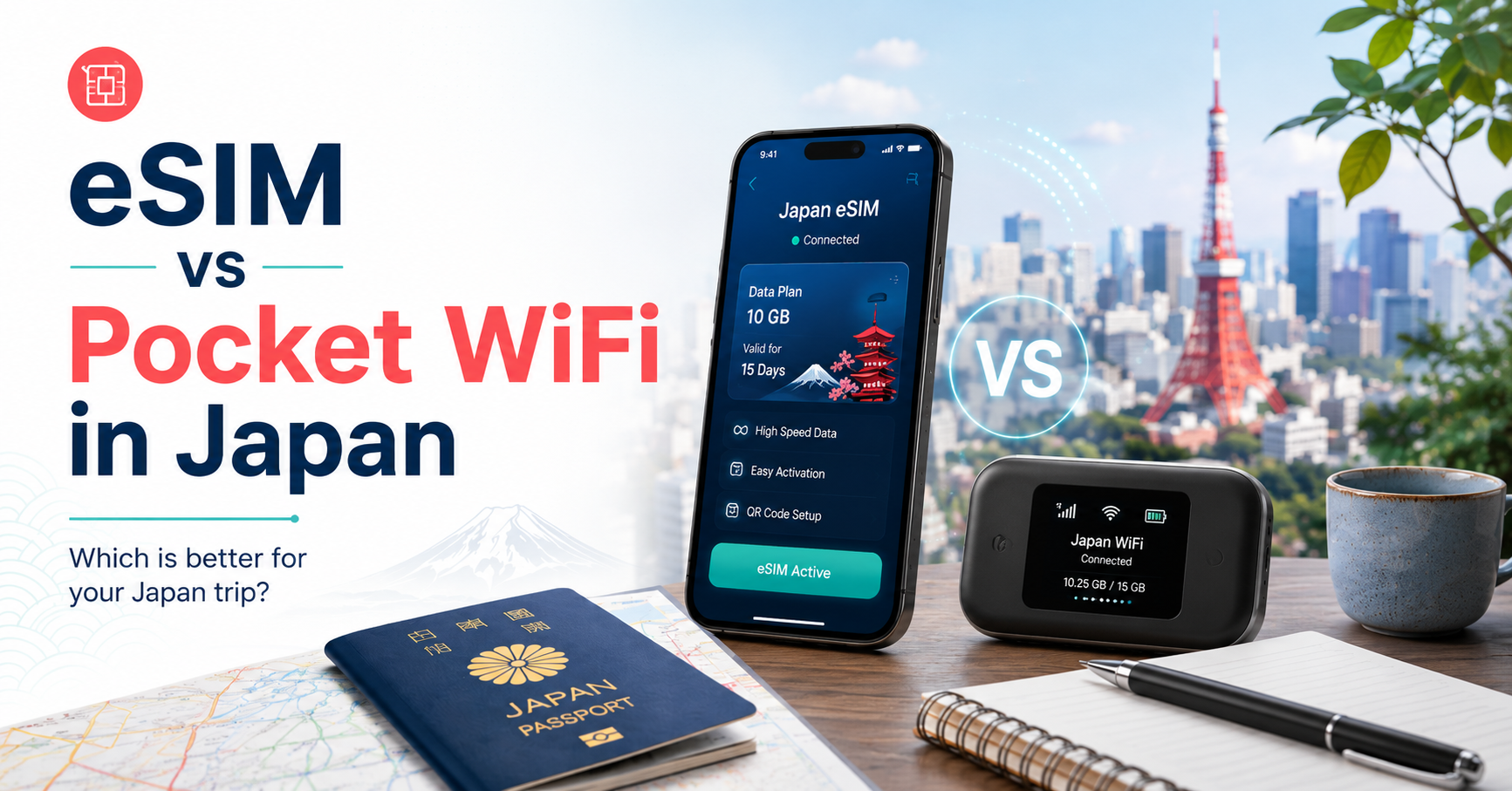
Planning a trip to Japan and wondering whether you should use an eSIM or Pocket WiFi?
If you’re comparing eSIM vs Pocket WiFi in Japan, the better choice depends on your phone, how many devices you need to connect, and how you travel. For the first few tasks after landing, also consider free Wi-Fi at Japan airports, which does not provide continuous coverage beyond the airport.
Your existing carrier’s international roaming is another option. See our Japan eSIM vs roaming price comparison before paying for extra connectivity.
Both can keep you connected while traveling, but they work in very different ways.
For most solo travelers, an eSIM is the simpler option because there is no extra device to carry, charge, pick up, or return.
Pocket WiFi can be a better choice if you need to connect several devices, are traveling as a group, or your phone does not support eSIM.
Looking for specific eSIM recommendations? See our Best eSIMs for Japan comparison. If you also want to consider a physical SIM, read our eSIM vs Pocket WiFi vs SIM Card guide.
Quick Answer: eSIM or Pocket WiFi?
Best for most solo travelers: eSIM
Pocket WiFi works well for groups that stay together. If you’ll split up, plan for separate connections.
Best for convenience: eSIM
Best for phones that do not support eSIM: Pocket WiFi
Best for avoiding an extra device: eSIM
Best for sharing one connection with several people: Pocket WiFi
Before buying an eSIM, check whether your phone supports eSIM and is unlocked.
eSIM vs Pocket WiFi in Japan: Quick Comparison
| Feature | eSIM | Pocket WiFi |
|---|---|---|
| Setup | Installed digitally on a compatible phone | Turn on the device and connect by WiFi |
| Extra device to carry | No | Yes |
| Multiple devices | Possible through phone hotspot on supported plans and devices | Designed to connect multiple WiFi devices |
| Battery | Uses your phone battery | Has its own rechargeable battery |
| Pickup and return | Not required | Usually required for rental services |
| Phone compatibility | Requires an eSIM-compatible and carrier-unlocked phone | Works with WiFi-capable devices |
| Best for | Solo travelers and convenience | Groups and multiple devices |
| Main drawback | Device compatibility and setup requirements | Extra device, charging, pickup, and return |
Swipe horizontally to view the full comparison →
The best choice depends on your phone, the number of people and devices you need to connect, and how much convenience you want during your trip.
What Is an eSIM?
An eSIM is a digital SIM that can be installed directly on a compatible smartphone without inserting a physical SIM card.
Travel eSIMs can usually be purchased online before your trip. After installation, many Japan plans activate when the phone first connects to a supported network in Japan.
An eSIM is especially convenient because you do not need to pick up or return a device.
Pros
✓ No extra device to carry
✓ No airport pickup or return
✓ Can often be installed before traveling
✓ Easy to switch between your regular SIM and travel data
✓ Good option for solo travelers
✓ Many plans are available for different trip lengths
Cons
× Requires an eSIM-compatible phone
× Your phone generally needs to be carrier-unlocked
× Setup can be confusing for first-time users
× Hotspot availability depends on the provider, plan, device, and network
Who it’s best for
An eSIM is usually the best choice for solo travelers who want a simple setup and do not want to carry another device.
It also works well for travelers who mainly need data on one smartphone for maps, messaging, translation, social media, and browsing.
What Is Pocket WiFi?
Pocket WiFi is a small portable router that connects to a mobile network and creates a private WiFi connection for nearby devices.
You connect to it in much the same way as home WiFi: turn the device on, select its network name, and enter the password.
Pocket WiFi can be especially useful when several people or several devices need to share one internet connection.
Pros
✓ Can connect multiple devices
✓ Useful for families and groups
✓ Works with WiFi-capable devices
✓ Can be used when a phone cannot use eSIM
✓ No eSIM installation required
Cons
× Another device to carry
× Needs to be charged
× Rental devices usually need to be picked up or delivered
× Rental devices usually need to be returned
× Loss or damage can create extra hassle or fees
Who it’s best for
Pocket WiFi is a strong option for groups, families, or travelers who want to connect several devices to one connection.
It is also useful if your phone is carrier-locked or does not support eSIM.
Sakura Mobile offers travel Pocket WiFi that works with WiFi-enabled devices such as smartphones, tablets, laptops, and game consoles.
NINJA WiFi also offers Pocket WiFi plans for travelers in Japan, including options designed for families and groups.
eSIM vs Pocket WiFi: Detailed Comparison
Setup and Convenience
With an eSIM, you can usually purchase and install your plan before you leave home. There is no rental device to collect after arriving in Japan and nothing to return before leaving.
Pocket WiFi is simple to use once you have the device, but you still need to receive or pick it up and later return it.
Winner for convenience: eSIM
Price
eSIM pricing varies depending on the provider, data allowance, and validity period. Small fixed-data packages can be inexpensive, while unlimited plans usually cost more.
Pocket WiFi is commonly rented by the day, so the total price increases with the length of your trip.
For one traveler, an eSIM will often be the more economical option. Pocket WiFi can become more attractive when several people share one device.
Typical advantage: eSIM for one traveler; Pocket WiFi may offer better value for groups.
Data Allowance
Both eSIM and Pocket WiFi services can offer large data allowances.
However, “unlimited” does not always mean unlimited full-speed data. Many services apply fair-use limits or reduce speeds after a certain amount of high-speed data has been used.
Always check the high-speed allowance and any speed-reduction policy before choosing a plan.
Winner: Depends on the specific plan
Multiple Devices
A Pocket WiFi is designed to create a WiFi network that several nearby devices can join.
An eSIM can also be shared through your phone’s hotspot feature when the plan and device support tethering, but your phone then acts as the router.
Winner for multiple devices: Pocket WiFi
Battery and Charging
An eSIM does not require a separate battery, although using your phone as a hotspot can increase battery consumption.
Pocket WiFi has its own rechargeable battery, so your phone does not need to handle the hotspot connection. The trade-off is that you have another device to keep charged.
Winner: eSIM for simplicity; Pocket WiFi if you want a separate hotspot device.
Coverage and Speed
Coverage and speed depend largely on the Japanese mobile network used by the provider, your location, network congestion, and device compatibility.
The connection method itself — eSIM or Pocket WiFi — does not automatically determine which will be faster.
Winner: Depends on the provider, network, location, and device.
Pickup and Return
An eSIM does not require physical pickup or return because the service is delivered digitally.
Rental Pocket WiFi normally requires you to collect or receive the router and return it after your trip.
Winner: eSIM
Phone Compatibility
An eSIM requires an eSIM-compatible and carrier-unlocked phone.
Pocket WiFi only requires your device to be able to connect to WiFi, making it useful for older phones, locked phones, tablets, laptops, and other devices that cannot use an eSIM directly.
Winner for compatibility: Pocket WiFi
Which Is Better for Different Travelers?
The better choice between eSIM vs Pocket WiFi in Japan depends on your travel style, number of devices, and phone compatibility.
Solo Travelers
Recommended: eSIM
For most solo travelers, an eSIM is easier because there is no additional device to carry, charge, pick up, or return.
Couples
Recommended: Usually eSIM
If both travelers have compatible phones, separate eSIMs are often the simplest solution.
Pocket WiFi may make sense if both travelers want to share one connection and expect to stay together most of the time.
Families and Groups
Recommended: Pocket WiFi
A shared Pocket WiFi can be convenient when several people need internet access at the same time.
One drawback is that everyone needs to remain reasonably close to the person carrying the router.
Business Travelers
Recommended: Depends on your devices
For a traveler mainly using one smartphone, an eSIM is convenient.
If you regularly need to connect a laptop, tablet, and several other devices, Pocket WiFi may be easier.
Long Stays
Recommended: Usually eSIM or a monthly mobile plan
For stays of several months, repeatedly renting Pocket WiFi may become less attractive. A monthly SIM, eSIM, or mobile plan may be more suitable.
Travelers With Older or Locked Phones
Recommended: Pocket WiFi
If your phone does not support eSIM or cannot be carrier-unlocked, Pocket WiFi is usually the safer option.
When Should You Choose an eSIM?
Choose an eSIM if:
✓ You are traveling alone
✓ Your phone supports eSIM
✓ Your phone is carrier-unlocked
✓ You want mobile data soon after arrival
✓ You do not want to collect or return rental equipment
✓ You want to keep the number of devices you carry to a minimum
Looking for specific options? →See our Best eSIMs for Japan comparison.
New to eSIM? →See our step-by-step guide on how to use an eSIM in Japan.
When Should You Choose Pocket WiFi?
When Should You Choose Pocket WiFi?
Considering Pocket WiFi? Compare Japan Wireless, Sakura Mobile, and NINJA WiFi in our Pocket WiFi guide.
Choose Pocket WiFi if:
✓ You are traveling with family or a group
✓ You want to connect several devices
✓ Your phone does not support eSIM
✓ Your phone is carrier-locked
✓ You frequently use a laptop or tablet
✓ You prefer a separate device to handle the internet connection
Frequently Asked Questions
For most solo travelers with a compatible phone, eSIM is more convenient. Pocket WiFi is usually better for groups, several devices, or phones that cannot use eSIM.
Yes. Pocket WiFi is designed to provide WiFi access to multiple nearby devices. The exact number depends on the router and provider.
Usually yes, because the phone connects to the router through WiFi instead of using a foreign SIM directly.
For rental services, usually yes. Pickup and return procedures vary by provider.
Normal eSIM use is simply mobile data use on your phone. However, using your phone as a hotspot for other devices can increase battery consumption.
Yes. They are independent connection methods. For example, one traveler can use an eSIM while other members of the group share a Pocket WiFi connection.
Final Recommendation
When comparing eSIM vs Pocket WiFi in Japan, there is no single best option for every traveler.
For most solo travelers visiting Japan, we recommend eSIM.
It is simple, requires no extra device, and avoids pickup and return procedures.
Choose Pocket WiFi if you are traveling with several people, need to connect many devices, or cannot use an eSIM on your phone.
There is no single winner for every traveler.
eSIM is best for simplicity and solo travel.
Pocket WiFi is best for sharing and device compatibility.
Affiliate Disclosure
Some links on this page may be affiliate links. NewtoJapan may receive a commission if you purchase through these links, at no additional cost to you. Our recommendations are based on our research and comparison criteria.